DPP readiness for wool semi-finished products · KVW3-00583
Towards a Wool Passport
The European digital product passport is on its way. In 2026 Hollands Wol Collectief worked out, with Regen Studio and CircularTech Forum, what it will ask of the wool chain. This page holds what we found, and what we are passing on.
The research
A product passport is a digital file attached to a product: what it is made of, how durable it is and how it should be handled at the end of its life. The duty to make one will most likely fall on our customers in textiles, furniture and construction. The data it needs starts in the chain.
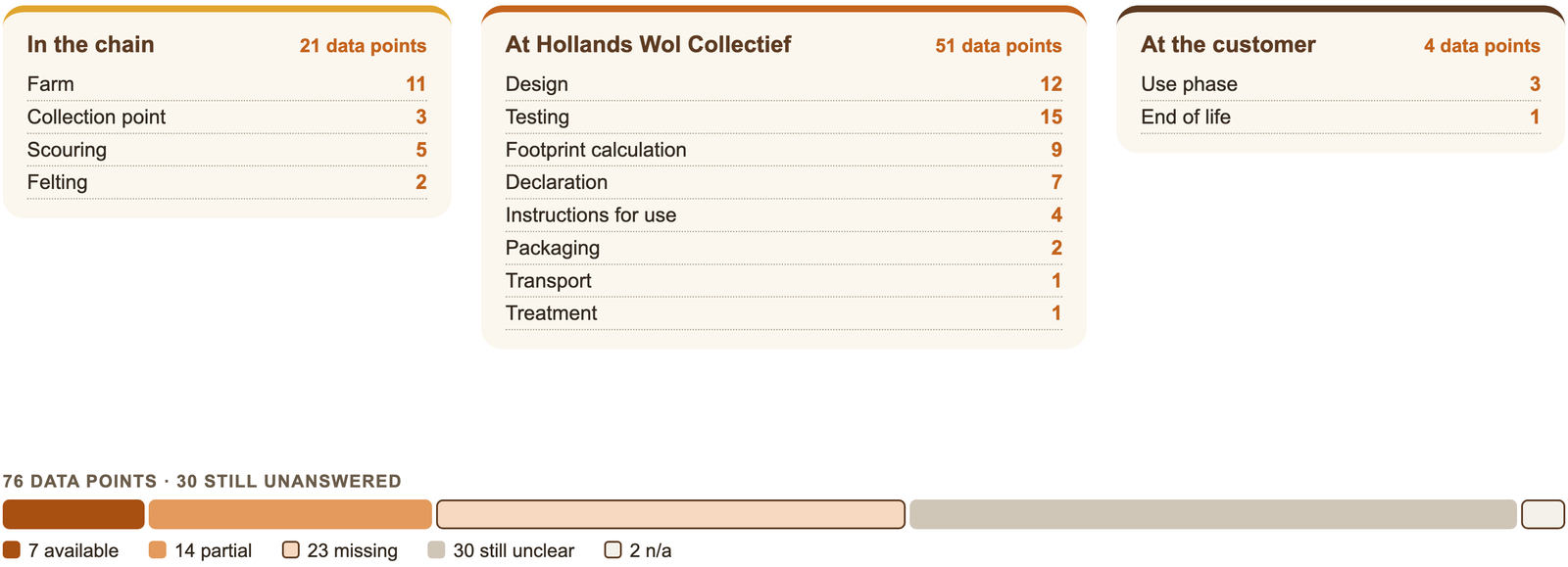
We mapped what the European rules may come to ask of our wool: 76 data points across fourteen stages, from design to the end of life.
-
A digital file attached to a product, opened through a QR code or a chip. It records what the product is made of, how durable it is and how it should be handled at the end of its life. For wool that means data such as origin, breed, scouring yield and the environmental footprint.
-
For semi-finished products such as fibre, yarn or felt, most likely not. The duty falls on whoever places the end product on the European market: a clothing brand, a furniture maker or a panel builder. Whoever places a construction product such as wool insulation on the market is its manufacturer under the construction products regulation. Duties under two regulations apply already: REACH and the packaging regulation.
-
The delegated act for textiles is expected to be adopted around the end of 2027. The obligations apply from mid-2029 at the earliest.
-
The European reference database holds one wool dataset, mostly Australian and New Zealand. Any European supplier without its own numbers falls back on it. The method also books the methane of the sheep and no carbon uptake.
-
Shared agreements for wool in the digital product passport: which fields belong in it, what they are called and what a value means. Our proposal is to work on this at European level, with central coordination, so that every member state collects the data the same way.
-
Regen Studio (https://www.regenstudio.world), an innovation studio that designs technical solutions, digital product passports among them, together with CircularTech Forum (https://circulartechforum.de), the international platform around the digital product passport. The client was Hollands Wol Collectief, with support from the European Union.
-
Regen Studio (https://www.regenstudio.world), at info@regenstudio.world (mailto:info@regenstudio.world), and CircularTech Advisory (https://www.circulartechadvisory.com), the consultancy of CircularTech Forum for readiness assessments, compliance roadmaps and passport implementation.
Frequently Asked Questions
Towards a Wool Passport
The calculation rules that name the wool dataset expire on 31 December 2027. New rules are expected after that, through the PEF. Six member states have an organisation whose subject is wool. In twenty-one none has been found yet.
Our proposal is to work at European level on sector standards for the challenges of digital product passports, with central coordination. The position paper on it will appear here soon.
The results
On 44 data points we could give an honest answer, which was about 32 percent. 30 data points are still unanswered.
The biggest problem lies outside the collective. The European reference database holds one wool dataset, mostly Australian and New Zealand. How you split the burden of a sheep over wool, meat and milk moves the result by a factor of two to nearly eight. Until there are European numbers, Dutch wool is judged on data of different wool.
The slides
 1 / 10
 2 / 10
 3 / 10
 4 / 10
 5 / 10
 6 / 10
 7 / 10
 8 / 10
 9 / 10
 10 / 10
The legacy
Hollands Wol Collectief stops on 1 November 2026. This page stays online available, with the slides in Dutch and English.
Do you work with wool in the Netherlands or elsewhere in Europe, or on the data side of textiles, furniture or construction? Get in touch with Regen Studio at regenstudio.world.
Execution

Co-funded by
This project is co-funded by the European Union through the European Regional Development Fund (ERDF), the Province of South Holland and Kansen voor West III. Project number KVW3-00583.